Before looking at a specific style for my interactive narrative, I need to decided on a story to develop into an interactive story.
Futuristic Red Riding Hood - Free Running (Mirrors edge style) player choses where to move to next (follow wolf, run away from wolf, head for "grandma"
Cinderella - Set in a different time period, chose who to run off with, prince, buttons, no one etc
Ballad if Reynardine -
Babes in the Wood -
Monday, 5 December 2011

Iteractive Narrative: Artists Research
Frank Miller is an artist, director and writer, best known for creating Sin City, 300 and pencilling numerous comics such as Daredevil and Batman. His unique dark, film noire style is something that attracted me to his work several years ago and I have been a fan of his work ever since. I even produced a piece of work inspired by his style for my A level Art.

Dave Mckean is an English illustrator, photographer, comic book artist, graphic designer, writer and musician. His work incorporates drawing, painting, photography, collage, found objects, digital art and sculpture. In 1989, he illustrated the Batman graphic novel, Arkham Asylum: A Serious House on Serious Earth, with writer Grant Morrison.
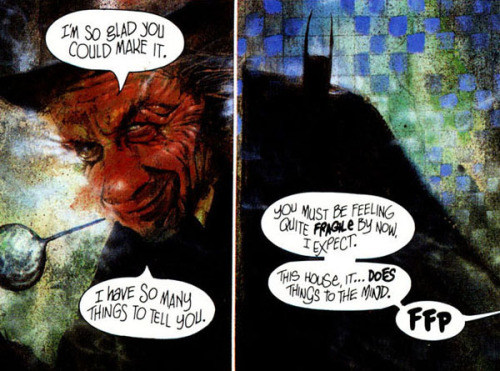
Kent Williams

Neil Gaiman
Writer: famous for creating the comic book series The Sandman and novels, Stardust, American Gods, Coraline and The Graveyard Book.
Shaun Tan
Bibliography:
http://en.wikipedia.org/wiki/Dave_McKean
http://fuckyeahgrantmorrison.tumblr.com/post/983650302/arkham-asylum-a-serious-house-on-serious-earth
Interactive Narrative
For this project we have been given to task to create an Interactive Narrative for web or iOS platforms, we have the option to design a:
Graphic Novel
OR
Cut Scene Animation
People need to be able interact with the novel or animation and make choices which will effect the story. Just like old Adventure Books, the story must branch off into different ways, depending on the choices the viewer makes.
We can re-imagine an existing story or create our own, but make sure the story is simple with lots of choices, rather than a complicated story with little or no choices to make.
Our task is to write the story for our Iterative Narrative over Christmas and try to make sure everything can be explained by the images and pieces of speech, (write story as a script rather than story) Make the setting clear (say a time and place maybe, but only if necessary).
Once I have decided on the story I will use, I will develop the story to contain options for the player to make and decid on how these will change the story. I will also develop a few character and environment ideas.
Finally I will design how my graphic novel or animation will look by creating multiple storyboards as well as developing more characters, environments and style
INITIAL IDEAS
These are the first ideas I have thought of since being given this project:
Stories to re-imagine:
My own ideas:
Idea 1: Influenced by the song Brianstorm by Arctic Monkeys - A man running towards a cliff edge being chased by police with dogs, as the music changes, he jumps of the cliff (falling/jumping in slow motion) and lands on the top of a tall building from the city below. This would be a short animation to give an introduction to the story.
Idea 2: Frank Miller style using his characters from Sin City, but making my own story. A short story where players take control of one of the prostitutes, Gail.

Ideas 3. An Assassin and her target.
First Choice: Chose where to hide
Second Choice: Stay hidden or confront
Third Choice: Chose how to assassinate your target (e.g. poison, blunt object, gun or sharp object)
These will effect the game in certain ways: Poison, best for staying quiet and not getting caught, but you will have to stay well hidden. Blunt object, you have to be close enough to target without being seen. Gun, will definitely kill target, but you will get caught, people will hear it. Sharp Object: similar to blunt object, but easier?)
Fourth Choice: What to do next: Move body, Search Body, leave body or
Fifth Choice: How to escape: Leave through the front door (if you searched the body will have collected a pass card thing, so people will assume you work there) . Jump out of the window
Graphic Novel
OR
Cut Scene Animation
People need to be able interact with the novel or animation and make choices which will effect the story. Just like old Adventure Books, the story must branch off into different ways, depending on the choices the viewer makes.
We can re-imagine an existing story or create our own, but make sure the story is simple with lots of choices, rather than a complicated story with little or no choices to make.
Our task is to write the story for our Iterative Narrative over Christmas and try to make sure everything can be explained by the images and pieces of speech, (write story as a script rather than story) Make the setting clear (say a time and place maybe, but only if necessary).
Once I have decided on the story I will use, I will develop the story to contain options for the player to make and decid on how these will change the story. I will also develop a few character and environment ideas.
Finally I will design how my graphic novel or animation will look by creating multiple storyboards as well as developing more characters, environments and style
INITIAL IDEAS
These are the first ideas I have thought of since being given this project:
Stories to re-imagine:
My own ideas:
Idea 1: Influenced by the song Brianstorm by Arctic Monkeys - A man running towards a cliff edge being chased by police with dogs, as the music changes, he jumps of the cliff (falling/jumping in slow motion) and lands on the top of a tall building from the city below. This would be a short animation to give an introduction to the story.
Idea 2: Frank Miller style using his characters from Sin City, but making my own story. A short story where players take control of one of the prostitutes, Gail.
Ideas 3. An Assassin and her target.
First Choice: Chose where to hide
Second Choice: Stay hidden or confront
Third Choice: Chose how to assassinate your target (e.g. poison, blunt object, gun or sharp object)
These will effect the game in certain ways: Poison, best for staying quiet and not getting caught, but you will have to stay well hidden. Blunt object, you have to be close enough to target without being seen. Gun, will definitely kill target, but you will get caught, people will hear it. Sharp Object: similar to blunt object, but easier?)
Fourth Choice: What to do next: Move body, Search Body, leave body or
Fifth Choice: How to escape: Leave through the front door (if you searched the body will have collected a pass card thing, so people will assume you work there) . Jump out of the window
Sunday, 27 November 2011
Contextual Studies: Final Presentation
After looking over my research on Reward and Punishment, I felt that it was stepping too far away for the subject of Coherent worlds, so instead I went back to looking at Character and True Character to create a Coherent World.
Why is a Coherent World Important?A coherent world is a world which can be completely fictional yet still clear to understand and believable. It is necessary to create a fictional world that is believable so the viewer or player can be easily immersed into a foreign world that yet still makes sense. Without coherency within gaming worlds, players will find it harder to fully absorb the world before them and lose focus on the main story or character. An example of lack of coherence would be to see a sports car whizzing across the desert of an old western, with a young teenager donned in denim and nylon behind the wheel. These futuristic assets would not make sense in a late 19th century setting because they we’re not invented at this time. The feeling of being immersed in this old cowboys and Indians setting would be lost completely. However, if we add a mad professor and explain that the car is actually a time machine, suddenly the world becomes believable again and thus coherent. This is a good example to show that fictional worlds can be strange and impossible, as long as there is evidence to support its reason for being there, and these things that are out of place explained, the world will keep its coherency.
There are many different elements that aid in making a coherent world, not only must the physical world make sense, but so must the narrative, and characterisations. Characterisation is an important element in creating a coherent world because without a believable main character, the immersion is lost. Ultimately, the main character is what links the player to the gaming world, and through which they experience it. The main character needs to make sense to the player so they can connect to them and fully take on the role. Just like an actor understanding his or her role in a play, the player must understand what role they are playing to be fully immersed. A bad example would be to take a character like Professor Layton, intellectual, gentlemanly and calm and place him into first person shooter, like call of duty. These characteristics would not suit a battle torn soldier and instead confuse the player. However, if our hero was put into a pressurising situation that showed his true character to be a cold blooded killer in the heat of battle, the player would then accept this.
What is a True Character?
Robert McKee argues that a characters characterisations are a false personality of someone they would like to be, and that their "True Character" is only shown when they are forced to react under pressure. An example of this can be seen in the character of Sam in Lord of the Rings, through out most of the saga, he is the nervous side kick hidden in the shadows of Frodo’s heroics, dreaming of nothing more than a quite life in The Shire. Yet when Sam is put under pressure, or his friends life is in danger, his true character of a brave and fiercely loyal hero shines through. This loyalty shown when we see his true character makes his actions believable and understandable, its clear he would not leave his quiet, safe life for no one other than Frodo. If Sam did not show this brave loyalty, the audience would be confused as to why he would embark on such a dangerous journey and therefore the story world would not be coherent.
How does a True Character establish a coherent world?
A true character is necessary to establish a coherent world because it helps reinforce the players belief in the narrative world. A character with depth, shown through the “true character” draws us into the character as well as the gaming world, whereas a flat character can be hard to connect to and therefore disconnect us from the surrounding world, because as I mentioned before, the character is the link between the gaming world and the immersion of the player. An example of this can be seen in the character of Tidus’ from Final Fantasy X, his character is that of a cocky, carefree, sports star focused solely on himself and his career, yet as the game proceeds, his true character shines through as a compassionate and caring hero . The players role as Tidus is to aid the saviour Yuna as part of a group of guardians in her quest to rid the world of Sin and bring eternal calm. Without seeing this “true character” of compassion from Tidus, his aiding of these other characters would not be coherent because his characterisations would not match his actions. His compassion and care for not only Yuna but the other guardians as well is what the player holds onto when we see him make the final sacrifice at the end of the game. In conclusion, characters can be mixed and diverse, as long as their true character reflects their actions and placement in the world.
Player input onto character
How I have used this.In my own project, “Fred”, I have had to think hard about how to present my main characters characterisation as well as her “true character”. The story is based around Fred losing her memory, part of which will be her characterisations. The player will learn of Fred’s character as the game progress’ yet will start out with a basic naive and confused character, adding more characteristics as the game progress’ as well as hints of true character shining through at important scenarios of the game. It is important that Fred’s character is coherent with the rest of the world, yet not be too obvious to give away too much of the mystery too soon. For example, if the game gives away Freds true character of a protective daughter who is in fact much cleverer than she pretends, then this will take away a lot of the mystery of “who is Fred?” and make little sense to some of the earlier actions. At the beginning of the game, Fred is naive and needs a lot of help from another character, if her true character was shown here, it would not make sense that she could not work things out on her own.
ConclusionIn conclusion to this presentation, I have established that character and “true character” are two separate entities used to create a character that belongs in a coherent world. The character provides a shell for us to play through and the true character gives reason for every thought action and speech the main character makes. Therefore creating a coherent world.
Why is a Coherent World Important?A coherent world is a world which can be completely fictional yet still clear to understand and believable. It is necessary to create a fictional world that is believable so the viewer or player can be easily immersed into a foreign world that yet still makes sense. Without coherency within gaming worlds, players will find it harder to fully absorb the world before them and lose focus on the main story or character. An example of lack of coherence would be to see a sports car whizzing across the desert of an old western, with a young teenager donned in denim and nylon behind the wheel. These futuristic assets would not make sense in a late 19th century setting because they we’re not invented at this time. The feeling of being immersed in this old cowboys and Indians setting would be lost completely. However, if we add a mad professor and explain that the car is actually a time machine, suddenly the world becomes believable again and thus coherent. This is a good example to show that fictional worlds can be strange and impossible, as long as there is evidence to support its reason for being there, and these things that are out of place explained, the world will keep its coherency.
There are many different elements that aid in making a coherent world, not only must the physical world make sense, but so must the narrative, and characterisations. Characterisation is an important element in creating a coherent world because without a believable main character, the immersion is lost. Ultimately, the main character is what links the player to the gaming world, and through which they experience it. The main character needs to make sense to the player so they can connect to them and fully take on the role. Just like an actor understanding his or her role in a play, the player must understand what role they are playing to be fully immersed. A bad example would be to take a character like Professor Layton, intellectual, gentlemanly and calm and place him into first person shooter, like call of duty. These characteristics would not suit a battle torn soldier and instead confuse the player. However, if our hero was put into a pressurising situation that showed his true character to be a cold blooded killer in the heat of battle, the player would then accept this.
What is a True Character?
Robert McKee argues that a characters characterisations are a false personality of someone they would like to be, and that their "True Character" is only shown when they are forced to react under pressure. An example of this can be seen in the character of Sam in Lord of the Rings, through out most of the saga, he is the nervous side kick hidden in the shadows of Frodo’s heroics, dreaming of nothing more than a quite life in The Shire. Yet when Sam is put under pressure, or his friends life is in danger, his true character of a brave and fiercely loyal hero shines through. This loyalty shown when we see his true character makes his actions believable and understandable, its clear he would not leave his quiet, safe life for no one other than Frodo. If Sam did not show this brave loyalty, the audience would be confused as to why he would embark on such a dangerous journey and therefore the story world would not be coherent.
How does a True Character establish a coherent world?
A true character is necessary to establish a coherent world because it helps reinforce the players belief in the narrative world. A character with depth, shown through the “true character” draws us into the character as well as the gaming world, whereas a flat character can be hard to connect to and therefore disconnect us from the surrounding world, because as I mentioned before, the character is the link between the gaming world and the immersion of the player. An example of this can be seen in the character of Tidus’ from Final Fantasy X, his character is that of a cocky, carefree, sports star focused solely on himself and his career, yet as the game proceeds, his true character shines through as a compassionate and caring hero . The players role as Tidus is to aid the saviour Yuna as part of a group of guardians in her quest to rid the world of Sin and bring eternal calm. Without seeing this “true character” of compassion from Tidus, his aiding of these other characters would not be coherent because his characterisations would not match his actions. His compassion and care for not only Yuna but the other guardians as well is what the player holds onto when we see him make the final sacrifice at the end of the game. In conclusion, characters can be mixed and diverse, as long as their true character reflects their actions and placement in the world.
Player input onto character
How I have used this.In my own project, “Fred”, I have had to think hard about how to present my main characters characterisation as well as her “true character”. The story is based around Fred losing her memory, part of which will be her characterisations. The player will learn of Fred’s character as the game progress’ yet will start out with a basic naive and confused character, adding more characteristics as the game progress’ as well as hints of true character shining through at important scenarios of the game. It is important that Fred’s character is coherent with the rest of the world, yet not be too obvious to give away too much of the mystery too soon. For example, if the game gives away Freds true character of a protective daughter who is in fact much cleverer than she pretends, then this will take away a lot of the mystery of “who is Fred?” and make little sense to some of the earlier actions. At the beginning of the game, Fred is naive and needs a lot of help from another character, if her true character was shown here, it would not make sense that she could not work things out on her own.
ConclusionIn conclusion to this presentation, I have established that character and “true character” are two separate entities used to create a character that belongs in a coherent world. The character provides a shell for us to play through and the true character gives reason for every thought action and speech the main character makes. Therefore creating a coherent world.
Wednesday, 23 November 2011
Contextual Studies: Reward and Punishment
While researching things to talk about for my contextual studies presentation, I often found myself referring to rewards and punishment, and how a balance between these two things must exist to create a coherent world, so I have decided to focus on this topic. The balance between these two is important because a game that rewards the player too much can make it too easy and thus boring. This works in the other direction, a game that punishes the players actions too much can make the game hard and seem unfair especially if there is no apparent reasoning for this.
Physical In Game Rewards: Money, Items (better weapons), points etc.
Player Satisfaction:
I have divided these types of rewards and punishments into different groups
In game rewards and punishments:
Characters Moral: Good characters get rewarded, Bad characters should show some sort of punishment, if not it is not just or coherent.
In game laws/Rules: Law enforcers etc.
Player rewards and punishments:
Game Difficulty: Player choices that can effect how easy or hard the game play is: these are often combined with game moral choices.
Player Satisfaction: Things that do not affect the game play, but rewards the player for completing a task (e.g. FFX-2 bonus ending for completing 100%)
Examples of reward and punishment in games and why these create a coherent world:
GTA series: I have looked into the Grand Theft Auto series in a previous blog. Ultimately, the police are your enemy in this game, yet there are still rules set in place so you understand why they come after you.
And example of this would be, while roaming the city, if you're character commits a crime, only then will the police come after you. The more severe the crimes, the more police and more force. This type of punishment creates a coherent world because we know the setting is of a real city and therefore expect these reactions to the breaking of such laws. Without this, the player would not feel fully immersed into the gaming experience. The main point of the game is you're playing as a criminal, therefore the player expects a body of law enforcement to react to their actions. Part of the fun in these games is to do something bad and the thrill of getting caught or trying to at least out run this as long as possible. If you did not get punished in someway for this, that fear would go and so the excitement would be lost.
Bioshock: You have the choice to Harvest or save a Little Sister
Fable:
Final Fantasy X-2:
Portal 2: Some games reward the player for being fully immersed into the game. An example of this can be explained through a personal experience of mine while playing the game Portal 2. In Portal, you play as a young woman named Chell, seemingly trapped in a laboratory forced to undergo puzzles described as tests. Your reasons as to why you are in this laboratory is kept a mystery throughout the game. In a section of the game, I was informed that the scene in front of me was the result of a "Bring your daughter to work day" which intrigued me and so I began looking more closely at each project. They all presented the idea of being created by young children, and the last one lead to the discovery of a project made "by chell", the same name as the main character.

Reward and Punishment is necessity for games that require the player to make choices:
Look at Fable 3 and Heavy Rain.
Physical In Game Rewards: Money, Items (better weapons), points etc.
Player Satisfaction:
I have divided these types of rewards and punishments into different groups
In game rewards and punishments:
Characters Moral: Good characters get rewarded, Bad characters should show some sort of punishment, if not it is not just or coherent.
In game laws/Rules: Law enforcers etc.
Player rewards and punishments:
Game Difficulty: Player choices that can effect how easy or hard the game play is: these are often combined with game moral choices.
Player Satisfaction: Things that do not affect the game play, but rewards the player for completing a task (e.g. FFX-2 bonus ending for completing 100%)
Examples of reward and punishment in games and why these create a coherent world:
GTA series: I have looked into the Grand Theft Auto series in a previous blog. Ultimately, the police are your enemy in this game, yet there are still rules set in place so you understand why they come after you.
And example of this would be, while roaming the city, if you're character commits a crime, only then will the police come after you. The more severe the crimes, the more police and more force. This type of punishment creates a coherent world because we know the setting is of a real city and therefore expect these reactions to the breaking of such laws. Without this, the player would not feel fully immersed into the gaming experience. The main point of the game is you're playing as a criminal, therefore the player expects a body of law enforcement to react to their actions. Part of the fun in these games is to do something bad and the thrill of getting caught or trying to at least out run this as long as possible. If you did not get punished in someway for this, that fear would go and so the excitement would be lost.
Bioshock: You have the choice to Harvest or save a Little Sister
Fable:
Final Fantasy X-2:
Portal 2: Some games reward the player for being fully immersed into the game. An example of this can be explained through a personal experience of mine while playing the game Portal 2. In Portal, you play as a young woman named Chell, seemingly trapped in a laboratory forced to undergo puzzles described as tests. Your reasons as to why you are in this laboratory is kept a mystery throughout the game. In a section of the game, I was informed that the scene in front of me was the result of a "Bring your daughter to work day" which intrigued me and so I began looking more closely at each project. They all presented the idea of being created by young children, and the last one lead to the discovery of a project made "by chell", the same name as the main character.
Reward and Punishment is necessity for games that require the player to make choices:
Look at Fable 3 and Heavy Rain.
Monday, 21 November 2011
Composition
Composition is important to create an image that is appealing to the eye and draws the viewer on a journey around the image towards the focal point.There are multiple types of Compositions that can be used to create such an image.
Rule of Thirds: Divides the image into thirds, and where these lines cross, gives 4 focus points.
Divine Proportion: This is creating a perfect swirl that draws the eye to the focus point
The "L": Frame within a frame
The Cross: Vertical Leading line and horizontal is the stopped. Usually the main focus will be on the leading line and the stopper line will show a contrast in colour or light (e.g. top half show lots of light with little shadow, bottom lots of shadow with little light.
Iconic: This composition is used a lot for hero poses, it pulls focus straight into the centre on multiple angles.
Below are 3 images by the artist Loish, each showing a different style of composition.
 This image shows the rule of thirds, two thirds make up the surreal arms and tentacles, and the main focus of the sleeping girl takes up the final third. Her face appears in the top right section which the eye is naturally drawn to.
 Here, Loish has used an "L" composition, with the buildings towering and framing the main focus of the boy jumping.
 This is a good example of an Iconic composition. The bottom of the top diamond framers her face almost perfectly. The peacock, the girls body angle and upper arms follow the diagonal line, and lower arms follow opposing angled lines almost perfectly. Even the bottom of the jacket flicks out to follow the angle of diagonal line.
Bibliography
http://loish.net/
Rule of Thirds: Divides the image into thirds, and where these lines cross, gives 4 focus points.
Divine Proportion: This is creating a perfect swirl that draws the eye to the focus point
The "L": Frame within a frame
The Cross: Vertical Leading line and horizontal is the stopped. Usually the main focus will be on the leading line and the stopper line will show a contrast in colour or light (e.g. top half show lots of light with little shadow, bottom lots of shadow with little light.
Iconic: This composition is used a lot for hero poses, it pulls focus straight into the centre on multiple angles.
Below are 3 images by the artist Loish, each showing a different style of composition.


Bibliography
http://loish.net/
Using Light
Lighting is so important when creating images because without light there will be no colour, no form and no distance. Light reacts in number of ways when it hits an object, these are:
Absorption: This is where all of the light is absorbed
Reflection: This is where no light is absorbed and all of the light bounces off the object at a 90 degree angle.
Refraction: This is when light hits a translucent surface and the light is bent at an angle through the surface (like a bubble)
We see colour depending of what colour is absorbed and what is reflected. For example, a green object will absorb every colour except from green. A white object will reflect all colours ad absorb none whereas black will absorb all colour and reflect none.
Diffused Reflection is what happens when light hits an uneven surface, each ray is reflected at different angles at random.
The Fresnel Effect, this is used when describing how the angle you see light at can change what you are seeing. A good example can be seen in pictures of water, where the light hits the water further away, light is reflected of the top of the water and this is what is seen, whereas at a sharper angle where the water is closer to the viewer, light can be seen to refract and begin to show what is under the water.
Another tip to remember is when multiple rays of light cross, the more intense the light will be.
Shadows are the result of light being blocked by an object, depending on the intensity of the light, the darker and sharper the shadow will be. Shadow also gives distance, it shows hows far the object is from the light source, again the closer the light, the sharper and darker the shadow.
Sub surface scattering is when some light is reflected and some refracted. A good example of this is looking at someones ear when a bright light is shining behind it. The refracted light will give off a glowing effect.
Colour is simply a trick of light, and colours will effect each other. For example Red and Green will compliment each other, add green and reds will stand out more and vice verse.
This is an image by Loish, here the light source seems to be coming from the jellyfish as well as an outdoor light source. The jellyfish is showing a good example of subsurface scattering and gives of an orange glow.

This is another image by Loish, here she has used the Fresnel effect, the water at the top of the image, closest to the viewer, shows light completely reflected and the hairs reflection as it fades back. the light source is clearly coming from above the water, being refracted in all directions under the surface and losing intensity as the water becomes deeper.

This is another image by Loish, here there is an clear intense light source coming from outside of the bus and light is being refracted in the water of the goldfish bowl and reflected onto her chest, arm and leg. The blue from her shirt is also being reflected into the bowl.

Bibliography
http://loish.net/
Absorption: This is where all of the light is absorbed
Reflection: This is where no light is absorbed and all of the light bounces off the object at a 90 degree angle.
Refraction: This is when light hits a translucent surface and the light is bent at an angle through the surface (like a bubble)
We see colour depending of what colour is absorbed and what is reflected. For example, a green object will absorb every colour except from green. A white object will reflect all colours ad absorb none whereas black will absorb all colour and reflect none.
Diffused Reflection is what happens when light hits an uneven surface, each ray is reflected at different angles at random.
The Fresnel Effect, this is used when describing how the angle you see light at can change what you are seeing. A good example can be seen in pictures of water, where the light hits the water further away, light is reflected of the top of the water and this is what is seen, whereas at a sharper angle where the water is closer to the viewer, light can be seen to refract and begin to show what is under the water.
Another tip to remember is when multiple rays of light cross, the more intense the light will be.
Shadows are the result of light being blocked by an object, depending on the intensity of the light, the darker and sharper the shadow will be. Shadow also gives distance, it shows hows far the object is from the light source, again the closer the light, the sharper and darker the shadow.
Sub surface scattering is when some light is reflected and some refracted. A good example of this is looking at someones ear when a bright light is shining behind it. The refracted light will give off a glowing effect.
Colour is simply a trick of light, and colours will effect each other. For example Red and Green will compliment each other, add green and reds will stand out more and vice verse.
This is an image by Loish, here the light source seems to be coming from the jellyfish as well as an outdoor light source. The jellyfish is showing a good example of subsurface scattering and gives of an orange glow.
This is another image by Loish, here she has used the Fresnel effect, the water at the top of the image, closest to the viewer, shows light completely reflected and the hairs reflection as it fades back. the light source is clearly coming from above the water, being refracted in all directions under the surface and losing intensity as the water becomes deeper.
This is another image by Loish, here there is an clear intense light source coming from outside of the bus and light is being refracted in the water of the goldfish bowl and reflected onto her chest, arm and leg. The blue from her shirt is also being reflected into the bowl.
Bibliography
http://loish.net/
Sunday, 20 November 2011
Project 2: Final Development of Fred
The Fred I chose to be developed fully was the second Fred, I felt she looked more unique and would appeal to a teen audience more than the other two.
This is the character sheet for Fred: As you can see I have experimented with colour schemes and expressions.

This is the Model Sheet for Fred: Her main colours are greeny/blues and oranges. Her hat, gloves, shoes and scarf are orange because these will stand out as main points of movement in game.
Finally, this is an image of Fred at the end of a maze corridor, deciding which way she should go.

This is the character sheet for Fred: As you can see I have experimented with colour schemes and expressions.

This is the Model Sheet for Fred: Her main colours are greeny/blues and oranges. Her hat, gloves, shoes and scarf are orange because these will stand out as main points of movement in game.

Finally, this is an image of Fred at the end of a maze corridor, deciding which way she should go.

Contextual Studies: Presentation Research
For my presentation I have decided to focus on Character vs True character, and how the two are necessary in creating a coherent world when the games character has moral choices to make.
True Character vs. Character
My hypothesis: Many video games involve “enemies” to your character. To be a coherent world, the player must feel a sense of reason by defeating these enemies, whether it’s for self-defence (example: people attacking you) seeking justice/revenge (enemies are “evil” ) or some other significant motivation. If this is not apparent, the player can lose contact with the character, having no relation to the character or their actions.
In games where you play as a villain or play against the law, there usually needs to be a higher evil or corrupt government to give the player a sense of approval for their actions. An an example of this can be seen in the Grand Theft Auto game series. In these GTA games, the main character is playing against the side of the law and the story takes the player through different acts of corruption, including drug dealing, arms and weapons, and murder. As a sandbox game, there is a certain amount of free will for the player outside of the main story. The player can drive how they like, attack who they like and pretty much commit whatever crimes they wish within the game, they are rewarded yet punished for these actions (murdered victims drop money, yet police will come after you) and so this free will gives the player a sense of justice and choice to be morally abiding or not. In a game about crime, without the risk of punishment, the game would not be creating a coherent world.
Superheroes: Very black and white Good vs. Evil
Not all games produce such a black and white outlook on good vs evil. Often the main character is stuck somewhere between these two contrasting sides and their character and True character must reflect this understanding of not being wholly good whilst still showing a sense of right doing. A character I chose to look at is Ezio from the Assassins Creed series. Like many superheroes, Ezio has two identities, "The Assassin" and "Ezio Auditore de Firenze" who, on their own would not make sense, yet together create a sense of cohesion in the world.
The character of The Assassin: If we look at the character of "The Assassin" on his own, he is a murderer and someone to be feared. Without the character of Ezio, we would not be able to relate to this character or understand his actions.
The character of Ezio: It could be argued that this is Ezios "true character", he is shown to be a young naive adolescent, who is thrown into the role of being an assassin to seek vengeance on those who killed his brothers and father, to protect his surviving family and to bring down a corrupt government to save his home. These reasons for a corrupt lifestyle are all easy to relate to, and so creates an understanding of why the player must commit such crimes as assassination and theft, creating a coherent world for the player to understand.
True Character vs. Character
My hypothesis: Many video games involve “enemies” to your character. To be a coherent world, the player must feel a sense of reason by defeating these enemies, whether it’s for self-defence (example: people attacking you) seeking justice/revenge (enemies are “evil” ) or some other significant motivation. If this is not apparent, the player can lose contact with the character, having no relation to the character or their actions.
In games where you play as a villain or play against the law, there usually needs to be a higher evil or corrupt government to give the player a sense of approval for their actions. An an example of this can be seen in the Grand Theft Auto game series. In these GTA games, the main character is playing against the side of the law and the story takes the player through different acts of corruption, including drug dealing, arms and weapons, and murder. As a sandbox game, there is a certain amount of free will for the player outside of the main story. The player can drive how they like, attack who they like and pretty much commit whatever crimes they wish within the game, they are rewarded yet punished for these actions (murdered victims drop money, yet police will come after you) and so this free will gives the player a sense of justice and choice to be morally abiding or not. In a game about crime, without the risk of punishment, the game would not be creating a coherent world.
Superheroes: Very black and white Good vs. Evil
Not all games produce such a black and white outlook on good vs evil. Often the main character is stuck somewhere between these two contrasting sides and their character and True character must reflect this understanding of not being wholly good whilst still showing a sense of right doing. A character I chose to look at is Ezio from the Assassins Creed series. Like many superheroes, Ezio has two identities, "The Assassin" and "Ezio Auditore de Firenze" who, on their own would not make sense, yet together create a sense of cohesion in the world.
The character of The Assassin: If we look at the character of "The Assassin" on his own, he is a murderer and someone to be feared. Without the character of Ezio, we would not be able to relate to this character or understand his actions.
The character of Ezio: It could be argued that this is Ezios "true character", he is shown to be a young naive adolescent, who is thrown into the role of being an assassin to seek vengeance on those who killed his brothers and father, to protect his surviving family and to bring down a corrupt government to save his home. These reasons for a corrupt lifestyle are all easy to relate to, and so creates an understanding of why the player must commit such crimes as assassination and theft, creating a coherent world for the player to understand.
Project 2: Developing Fred
These are the 20 best character developments I chose, developed from 6 silhouettes.
 Once I had completed my silhouettes and developed 6 different silhouettes, i took 3 of my favourites and began to develop these designs. The 3 I chose to develop are, the one top right, combination of the first two on the fourth row and second from left on bottom row. Experimenting with different colour schemes and clothing designs. Each one was very different to the other:
My first Fred looks much older than intended and her clothes too regal. I stopped developing her after I got to that point and focused on another style of Fred


My second Fred looks more younger with attitude which is better suited to the character of Fred

I really liked this style for Fred so decided to continue developing this.
My first Fred looks much older than intended and her clothes too regal. I stopped developing her after I got to that point and focused on another style of Fred


My second Fred looks more younger with attitude which is better suited to the character of Fred

I really liked this style for Fred so decided to continue developing this.
Saturday, 5 November 2011
Contextual Studies: Genre
Genre is the term for category of literature or any other media. Genres have certain characteristics that make them such genre, for example, a Tragedy genre, would include suffering, unfortunate events etc. However, many films, literature and games involve multiple genres.
A short exercise showed me that when we assume a genre, we read the story in a very different way. A short passage given the title "Murder at Marpelthorpe" was read to us, and automatically, my mind was put into a murder mystery, certain lines stood out, such as the clock being half 10 because i expected this to be a clue further on in the mystery. However, when given another title "The Personal History of David Marpelthorpe" how i listened/read the passage changed completely, instead my mind focused on the people, such as the crying infant in the background, I assumed would be a family member to "David Marpelthorpe".
We then answered a quiz where we had to name the game based on one image and then we discussed what genre we thought each game belonged to:
The Path - Thriller, Dark, Horror
Zelda: Twilight Princess - Adventure, Fantasy
Final Fantasy XIII Versus - Role Playing Game, Fantasy
Myst - Adventure
Dead Space - Survival, Sci-Fi Horror
L.A. Noire - Noire Thriller, Detective, 40s/50s Crime Drama
Heavy Rain - Drama, Noire Thriller
Angry Birds -
Alan Wake
Mortal Kombat
Red Dead Redemption
Resident Evil 4
A lot of the games had multiple genres, shared similar genres, and it could be argued that they all fall under the "Fantasy" genre because they're all make-believe. This task showed us that multiple genres can be combined to create diverse gaming, just like multiple characteristics make up a personality.
We then split into groups and were given the task to flip a genre on its head by taking one of these games and giving it the genre of another. We were given the game Angry Birds, and asked to flip it into a noire thriller. This was an entertaining task, we started by thinking about all the things that make a noire to us, like black and white visuals, mafia type gangs and office scenes where the shadow of the blinds cut across faces. We decided we would give a new story to the birds, the birds would be an infamous gang fighting against a corrupt law enforcement represented by the pigs. The birds would throw cream pies (influenced by Bugsy Malone, a children's noire thriller) at corrupt police stations in order to break their gang members out of prison. This showed us that keeping the same game play, but changing certain elements can completely change a game.
A short exercise showed me that when we assume a genre, we read the story in a very different way. A short passage given the title "Murder at Marpelthorpe" was read to us, and automatically, my mind was put into a murder mystery, certain lines stood out, such as the clock being half 10 because i expected this to be a clue further on in the mystery. However, when given another title "The Personal History of David Marpelthorpe" how i listened/read the passage changed completely, instead my mind focused on the people, such as the crying infant in the background, I assumed would be a family member to "David Marpelthorpe".
We then answered a quiz where we had to name the game based on one image and then we discussed what genre we thought each game belonged to:
The Path - Thriller, Dark, Horror
Zelda: Twilight Princess - Adventure, Fantasy
Final Fantasy XIII Versus - Role Playing Game, Fantasy
Myst - Adventure
Dead Space - Survival, Sci-Fi Horror
L.A. Noire - Noire Thriller, Detective, 40s/50s Crime Drama
Heavy Rain - Drama, Noire Thriller
Angry Birds -
Alan Wake
Mortal Kombat
Red Dead Redemption
Resident Evil 4
A lot of the games had multiple genres, shared similar genres, and it could be argued that they all fall under the "Fantasy" genre because they're all make-believe. This task showed us that multiple genres can be combined to create diverse gaming, just like multiple characteristics make up a personality.
We then split into groups and were given the task to flip a genre on its head by taking one of these games and giving it the genre of another. We were given the game Angry Birds, and asked to flip it into a noire thriller. This was an entertaining task, we started by thinking about all the things that make a noire to us, like black and white visuals, mafia type gangs and office scenes where the shadow of the blinds cut across faces. We decided we would give a new story to the birds, the birds would be an infamous gang fighting against a corrupt law enforcement represented by the pigs. The birds would throw cream pies (influenced by Bugsy Malone, a children's noire thriller) at corrupt police stations in order to break their gang members out of prison. This showed us that keeping the same game play, but changing certain elements can completely change a game.
Thursday, 3 November 2011
Project 2: Character - Initial Designs
This is the next stage to my development of Freds Character. After making the 100 silhouettes, I took 6 designs I liked, drew them into photoshop and began making some sketches over top.


These are some hair designs I did for Fred, I wanted to get a unique shape for the hair and so, like the silhouettes, i simple made shapes to see what they would look like.
Contextual Studies: Character
There are many different aspects that make up a character within any media:
The signifier, which signifies how the character can be recognized. An example of this is Whinnie the Poohs red shirt he always wears. No matter what style this character is drawn in, his red shirt signifies to the viewer that this is "that" specific character, Whinnie the Pooh.
A characters name is also important, the main character in Fable is named "Hero" which gives connotations of heroism and being good, yet this is also an empty name, with the player being able to decide on what kind of hero "Hero" will be. Pip, the main character from Great Expectations, also has a name that gives ideas of something else. The name "Pip" leads to the idea of "Seed" which gives connotations of something being ready to grow and evolve.
Robert McKee argues that characters have characterisations, a false personality of someone they would like to be, and that their "True Character" is only shown when they react under pressure. An example would be Spider-man is Peter Parker's characterisation, a mask under which he hides, yet his true character is the awkward teenager.
Ezio Auditore Da Firenze:
The characterisation of this character is one of a suave, charming expert assassin, donned in a white hooded robe. A "hero" who roams the streets of Italy, fighting a revolution against those who are corrupting his country. However, his true character is one of a young, grieving adolescent, forced to take on this role in vengeance after his father and brothers are murdered. This "true" character is rarely seen, except in times of desperation and pressure. His physical character changes too, he is often shown wearing regular clothes, unhooded or semi-nude, as if to represent a sign of true self and/or the weakness he feels like this. A complete opposite to his "armoured" robed self.
The signifier, which signifies how the character can be recognized. An example of this is Whinnie the Poohs red shirt he always wears. No matter what style this character is drawn in, his red shirt signifies to the viewer that this is "that" specific character, Whinnie the Pooh.
A characters name is also important, the main character in Fable is named "Hero" which gives connotations of heroism and being good, yet this is also an empty name, with the player being able to decide on what kind of hero "Hero" will be. Pip, the main character from Great Expectations, also has a name that gives ideas of something else. The name "Pip" leads to the idea of "Seed" which gives connotations of something being ready to grow and evolve.
Robert McKee argues that characters have characterisations, a false personality of someone they would like to be, and that their "True Character" is only shown when they react under pressure. An example would be Spider-man is Peter Parker's characterisation, a mask under which he hides, yet his true character is the awkward teenager.
Ezio Auditore Da Firenze:
The characterisation of this character is one of a suave, charming expert assassin, donned in a white hooded robe. A "hero" who roams the streets of Italy, fighting a revolution against those who are corrupting his country. However, his true character is one of a young, grieving adolescent, forced to take on this role in vengeance after his father and brothers are murdered. This "true" character is rarely seen, except in times of desperation and pressure. His physical character changes too, he is often shown wearing regular clothes, unhooded or semi-nude, as if to represent a sign of true self and/or the weakness he feels like this. A complete opposite to his "armoured" robed self.
Project 2: Character and Environment Design
For our second project we have to bring a portion of our game to life by developing either a character or a section of environment. Artwork must reflect innovation and originality, from initial sketches right through to final concept.
I have decided to develop the main character in my game: Fred
I already had an initial idea of what Fred would look like that can be seen in the previous project. However, I have started back at the beginning of the design process to see where a full development will take me. To start I drew over 100 thumbnails using different shapes to get interesting silhouettes. Here are just some of these silhouettes:

My favourites from this page of silhouettes are the 4th one on the 3rd row, and the 3rd and 4th on the 4th row. All three give strong, recognizable silhouettes which is what I am looking for. Next I will develop these 3 silhouettes to design a black and white silhoette to give a better idea of more designs.
I have decided to develop the main character in my game: Fred
I already had an initial idea of what Fred would look like that can be seen in the previous project. However, I have started back at the beginning of the design process to see where a full development will take me. To start I drew over 100 thumbnails using different shapes to get interesting silhouettes. Here are just some of these silhouettes:

My favourites from this page of silhouettes are the 4th one on the 3rd row, and the 3rd and 4th on the 4th row. All three give strong, recognizable silhouettes which is what I am looking for. Next I will develop these 3 silhouettes to design a black and white silhoette to give a better idea of more designs.
Friday, 21 October 2011
Contextual Studies: Narrative Story Worlds
Characters: A good story needs to have distinct, believable characters. Many characters within stories will have definitive good or bad personalities so the player can define between the good and evil.
I personally, will often prefer the "false hero" or sometimes the "villain" in a story because their actions and morals are more realistic and easier to relate to. Heroes that are too perfect in their morals can sometimes feel too superior and arrogant or just unrealistic.
A successful story will be able to appeal to a mass audience, the franchise of Star Wars is a good example of this because it has multiple elements. The conflict and battle, best represented by the famous light sabres. It contains the young boy and his struggle and growth into becoming a hero seen through Luke Skywalker, it also contains romance between Hans Solo and Princess Leia. All of these genres appeal to many audiences, and the created world becomes a place every viewer can imagine themselves set in.
Physical story worlds can be seen in Theme Parks. They create a physical fantasy environment for visitors to explore, much like exploring a world in a video game, visitors can be immersed into whichever area they like.
Ludologists are people who believe play is more important in games whereas Narratologists are people who believe the story is more important in games. I believe games need a good balance between the two because if one was without the other, it would have to be exceptionally good to still be a good game. For example, if the game play was not very fun, the story would have to be gripping enough to make the player want to continue, and vice verse, if the story was not very exciting, or lacking, then the game play would have to be really fun to keep on playing. Games which started out with the game play idea, such as Portal and its unique puzzling game play, are proof that a vast and dynamic storyline is not necessary to create a good game, however, when you add a storyline, the world becomes more immersing and the player begins to care about the characters (such as Chell and the ever witty GLADOS) and continuing the game is about finding out where the story will lead, as well as the fun of the game.
A good story will introduce the problem within the first 5 minutes of the game/film/story so as to grip the viewer straight away.
TASK 1: Answer these questions:
a. What is the relationship between the main character and the goal of the game?
b. Why does the character care about the goal?
Answers in the context of the game Dragon Age: Origins
a. Ultimate goal is to survive, must defeat The Blight to do this.
b. The character suffers a tragedy at the beginning of the game, this leads to the joining of a group of warriors called Grey Wardens who are trained to defeat the Blight and it is their duty to protect the people of Fereldon. When another tragedy strikes, your character becomes one of only two surviving warriors, so the character feels compelled to take on the task.
TASK 2
a. Take a franchise (e.g. Star Wars)
b. Jot Down 5 Iconic Elements
c. Why are these elements memorable?
d. Why are they important elements to your chosen franchise?
The franchise I have chosen to look at is the Harry Potter franchise. Five iconic elements I think of are: Magic, the world is set in the real world, but with Magic, this makes almost anything possible, which is why it is both important and memorable. Hogwarts is another big element, it is important because it represents a home and sanctuary. Its memorable because it is where the majority of the story takes place. The third element I thought of is Harry's Scar, it is important for a number of ways, it represents the tragedy of Harry's situation, it identifies him, it is his signifier to both the reader and other characters in the book and it aids in the story (it burns at significant points of the book). All these aspects is what makes it so memorable. Another element I think of when I think of this franchise are the school houses. They are memorable because of their physical representation )colours, names and animals) as well as the characteristics they value. For example, Gryffindor is represented by the colours of Mahogany and Gold the Lion , this house values courage, bravery and chivalry. The houses are also important because they can group people together and give reason for them being together, it is unlikely that the trio would be friends if they weren't in the same house and forced to be in the same group. The final important element I think of is the character or Dumbledore, he is important because he plays so many roles within the story, almost every role of the 8 broad characters Vladimir Propp describes. He is a father figure to harry and many other students, he represents all knowledge and the rival to any evil, he also represents safety as most characters are shown to believe they are safe from the dark evil of Voldemort if he is around. He is almost as memorable as Harry because of all these things and shows a resemblance to what we know of Merlin from children's tales of King Arthur with the long white hair, beard and robes.
I personally, will often prefer the "false hero" or sometimes the "villain" in a story because their actions and morals are more realistic and easier to relate to. Heroes that are too perfect in their morals can sometimes feel too superior and arrogant or just unrealistic.
A successful story will be able to appeal to a mass audience, the franchise of Star Wars is a good example of this because it has multiple elements. The conflict and battle, best represented by the famous light sabres. It contains the young boy and his struggle and growth into becoming a hero seen through Luke Skywalker, it also contains romance between Hans Solo and Princess Leia. All of these genres appeal to many audiences, and the created world becomes a place every viewer can imagine themselves set in.
Physical story worlds can be seen in Theme Parks. They create a physical fantasy environment for visitors to explore, much like exploring a world in a video game, visitors can be immersed into whichever area they like.
Ludologists are people who believe play is more important in games whereas Narratologists are people who believe the story is more important in games. I believe games need a good balance between the two because if one was without the other, it would have to be exceptionally good to still be a good game. For example, if the game play was not very fun, the story would have to be gripping enough to make the player want to continue, and vice verse, if the story was not very exciting, or lacking, then the game play would have to be really fun to keep on playing. Games which started out with the game play idea, such as Portal and its unique puzzling game play, are proof that a vast and dynamic storyline is not necessary to create a good game, however, when you add a storyline, the world becomes more immersing and the player begins to care about the characters (such as Chell and the ever witty GLADOS) and continuing the game is about finding out where the story will lead, as well as the fun of the game.
A good story will introduce the problem within the first 5 minutes of the game/film/story so as to grip the viewer straight away.
TASK 1: Answer these questions:
a. What is the relationship between the main character and the goal of the game?
b. Why does the character care about the goal?
Answers in the context of the game Dragon Age: Origins
a. Ultimate goal is to survive, must defeat The Blight to do this.
b. The character suffers a tragedy at the beginning of the game, this leads to the joining of a group of warriors called Grey Wardens who are trained to defeat the Blight and it is their duty to protect the people of Fereldon. When another tragedy strikes, your character becomes one of only two surviving warriors, so the character feels compelled to take on the task.
TASK 2
a. Take a franchise (e.g. Star Wars)
b. Jot Down 5 Iconic Elements
c. Why are these elements memorable?
d. Why are they important elements to your chosen franchise?
The franchise I have chosen to look at is the Harry Potter franchise. Five iconic elements I think of are: Magic, the world is set in the real world, but with Magic, this makes almost anything possible, which is why it is both important and memorable. Hogwarts is another big element, it is important because it represents a home and sanctuary. Its memorable because it is where the majority of the story takes place. The third element I thought of is Harry's Scar, it is important for a number of ways, it represents the tragedy of Harry's situation, it identifies him, it is his signifier to both the reader and other characters in the book and it aids in the story (it burns at significant points of the book). All these aspects is what makes it so memorable. Another element I think of when I think of this franchise are the school houses. They are memorable because of their physical representation )colours, names and animals) as well as the characteristics they value. For example, Gryffindor is represented by the colours of Mahogany and Gold the Lion , this house values courage, bravery and chivalry. The houses are also important because they can group people together and give reason for them being together, it is unlikely that the trio would be friends if they weren't in the same house and forced to be in the same group. The final important element I think of is the character or Dumbledore, he is important because he plays so many roles within the story, almost every role of the 8 broad characters Vladimir Propp describes. He is a father figure to harry and many other students, he represents all knowledge and the rival to any evil, he also represents safety as most characters are shown to believe they are safe from the dark evil of Voldemort if he is around. He is almost as memorable as Harry because of all these things and shows a resemblance to what we know of Merlin from children's tales of King Arthur with the long white hair, beard and robes.
Wednesday, 19 October 2011
Puzzle and Maze Development
To give my game some variety, I have decided to include some puzzles into the mazes. Zelda games have been a big reference point for these puzzles as has Professor Layton.
Block puzzles: These types of puzzles involve pushing blocks around to get to a blocked or higher space, to press switches or to create a picture by combining the images on the blocks.
How I could use this in my game: Having items within the maze which Fred can push onto or off switches to open doors, or drop down ropes for Fred to climb up. Stacking items to create an image may also open doorways or reveal hidden rooms.
Enemy puzzles: These type of puzzles involve defeating enemies to proceed through the maze, to open doorways, recieve important items or to complete the level.
How I could use this in my game: Fred may have to trap certain enemies into boxes, rather than defeat enemies. However, I am still developing the idea of enemies being in the game.
Return Puzzles: This involves the player having to return to a pre-visited room to use a collected item.
How I could use this in my game: This would work well for Fred because it is set in a maze, certain treasures may be collected to unlock new areas of the mazes.
Switch Puzzles: This involves the player manipulating an object (such as a lever or button) with another object, such as a weight on a switch or "hookshot" on an out of reach lever.
How I could use this in my game: Fred could manipulate a rope to hold a lever into place, to rotate an object, or move it out of the way to get through a trapped corridor
Torch Puzzles: The player must light one or more torches to open a doorway or recieve an important item by transporting fire to the torches.
How I could use this in my game: This would be harder to incorporate into Fred, but the idea of transporting items, maybe via ropes may work. For example, swinging a rope to light two fires.
Other puzzle ideas:
Portal: Involves the player having to place transportation devices. These maybe usefull for my game, perhaps Fred could have two objects which he/she can drop in any part of the maze, so she can telepot between the two.
Bibliography:
http://www.zeldawiki.org/Puzzle
Block puzzles: These types of puzzles involve pushing blocks around to get to a blocked or higher space, to press switches or to create a picture by combining the images on the blocks.
How I could use this in my game: Having items within the maze which Fred can push onto or off switches to open doors, or drop down ropes for Fred to climb up. Stacking items to create an image may also open doorways or reveal hidden rooms.
Enemy puzzles: These type of puzzles involve defeating enemies to proceed through the maze, to open doorways, recieve important items or to complete the level.
How I could use this in my game: Fred may have to trap certain enemies into boxes, rather than defeat enemies. However, I am still developing the idea of enemies being in the game.
Return Puzzles: This involves the player having to return to a pre-visited room to use a collected item.
How I could use this in my game: This would work well for Fred because it is set in a maze, certain treasures may be collected to unlock new areas of the mazes.
Switch Puzzles: This involves the player manipulating an object (such as a lever or button) with another object, such as a weight on a switch or "hookshot" on an out of reach lever.
How I could use this in my game: Fred could manipulate a rope to hold a lever into place, to rotate an object, or move it out of the way to get through a trapped corridor
Torch Puzzles: The player must light one or more torches to open a doorway or recieve an important item by transporting fire to the torches.
How I could use this in my game: This would be harder to incorporate into Fred, but the idea of transporting items, maybe via ropes may work. For example, swinging a rope to light two fires.
Other puzzle ideas:
Portal: Involves the player having to place transportation devices. These maybe usefull for my game, perhaps Fred could have two objects which he/she can drop in any part of the maze, so she can telepot between the two.
Bibliography:
http://www.zeldawiki.org/Puzzle
Contextual Studies: Fairy Tales and Vladimir Propp
Original Fairy Tales have long been dark and violent tales intended to scare children and teach them morals. Their development has lead them to be happier tales, more suitable to provide children entertainment rather than teach them a lesson.
Examples of Fairy Tales in Video Games:
The Studio of Tale of Tales use old folklore and fairy tales in many of their games to provide a new twist on them. One of their most talked about games called The Path is a moody and strikingly poignant game inspired by the tale of Little Red Riding hood.
Disney has turned many fairy tales into classics and the game Kingdom Hearts has taken all of these fairy tale characters and integrated them into multiple plots that sees the most unlikely of characters to cross paths in their respective story worlds.
Vladimir Propp:
Vladimir Propp was a Russian and Soviet formalist scholar who wrote Morphology of the Folktale. In this book Propp looks at the study of narrative structure and by breaking down a large number of Russian Folktales, depicted 31 functions of a tale.
These functions are:
The Villain - one who struggles against the hero
The Donor - prepares the hero or gives them a magical item
The Helper - helps the hero in the quest
The Princess or Prize - The hero often deserves this but can not have it because of an unfair evil
The Father - gives the task to the hero, identifies the false hero
The Dispatcher - character who sends the hero off
The Hero - the seeker who reacts against the villain and dispatcher
The False Hero - disrupts the hero's quest (by taking credit for the hero's actions or marrying the princess etc)
Examples in Classic Fairy Tale: Little Mermaid
The Villain - Ursula
The Donor - Ursula
The Helper - Flounder and Sebastian
The Princess/Prize - Prince Eric
The Father - King Triton
The Dispatcher - King Triton's outrage sends Ariel off
The Hero - Ariel
The False Hero - Ursula (Human Form)
Examples in other media: Shakespeare's Hamlet
The Villain - Claudius
The Donor - The King
The Helper - Horatio
The Princess/Prize - Ophelia
The Father - The King
The Dispatcher - The King, Hamlets father
The Hero - Hamlet
The False Hero - Laertes
Example in a Video Game: Zelda:Ocarina of Time
The Villain - Ganondorf
The Donor - Saria: Gives Link the Ocarina/ Shiek: Gives Link Melodies to play
The Helper - Navi: Aids Link in his quest by constantly telling Link what to do next/ Epona
The Princess/Prize - Princess Zelda
The Father - Princess Zelda
The Dispatcher - The Deku Tree
The Hero - Link
The False Hero - Shiek
Bibliograohy
http://tale-of-tales.com/
http://en.wikipedia.org/wiki/Vladimir_Propp#Characters
Examples of Fairy Tales in Video Games:
The Studio of Tale of Tales use old folklore and fairy tales in many of their games to provide a new twist on them. One of their most talked about games called The Path is a moody and strikingly poignant game inspired by the tale of Little Red Riding hood.
Disney has turned many fairy tales into classics and the game Kingdom Hearts has taken all of these fairy tale characters and integrated them into multiple plots that sees the most unlikely of characters to cross paths in their respective story worlds.
Vladimir Propp:
Vladimir Propp was a Russian and Soviet formalist scholar who wrote Morphology of the Folktale. In this book Propp looks at the study of narrative structure and by breaking down a large number of Russian Folktales, depicted 31 functions of a tale.
These functions are:
- ABSENTATION: A member of a family leaves the security of the home environment. This may be the hero or some other member of the family that the hero will later need to rescue. This division of the cohesive family injects initial tension into the storyline. The hero may also be introduced here, often being shown as an ordinary person.
- INTERDICTION: An interdiction is addressed to the hero ('don't go there', 'don't do this'). The hero is warned against some action (given an 'interdiction').
- VIOLATION of INTERDICTION. The interdiction is violated (villain enters the tale). This generally proves to be a bad move and the villain enters the story, although not necessarily confronting the hero. Perhaps they are just a lurking presence or perhaps they attack the family whilst the hero is away.
- RECONNAISSANCE: The villain makes an attempt at reconnaissance (either villain tries to find the children/jewels etc.; or intended victim questions the villain). The villain (often in disguise) makes an active attempt at seeking information, for example searching for something valuable or trying to actively capture someone. They may speak with a member of the family who innocently divulges information. They may also seek to meet the hero, perhaps knowing already the hero is special in some way.
- DELIVERY: The villain gains information about the victim. The villain's seeking now pays off and he or she now acquires some form of information, often about the hero or victim. Other information can be gained, for example about a map or treasure location.
- TRICKERY: The villain attempts to deceive the victim to take possession of victim or victim's belongings (trickery; villain disguised, tries to win confidence of victim). The villain now presses further, often using the information gained in seeking to deceive the hero or victim in some way, perhaps appearing in disguise. This may include capture of the victim, getting the hero to give the villain something or persuading them that the villain is actually a friend and thereby gaining collaboration.
- COMPLICITY: Victim taken in by deception, unwittingly helping the enemy. The trickery of the villain now works and the hero or victim naively acts in a way that helps the villain. This may range from providing the villain with something (perhaps a map or magical weapon) to actively working against good people (perhaps the villain has persuaded the hero that these other people are actually bad).
- VILLAINY or LACK: Villain causes harm/injury to family member (by abduction, theft of magical agent, spoiling crops, plunders in other forms, causes a disappearance, expels someone, casts spell on someone, substitutes child etc., commits murder, imprisons/detains someone, threatens forced marriage, provides nightly torments); Alternatively, a member of family lacks something or desires something (magical potion etc.). There are two options for this function, either or both of which may appear in the story. In the first option, the villain causes some kind of harm, for example carrying away a victim or the desired magical object (which must be then be retrieved). In the second option, a sense of lack is identified, for example in the hero's family or within a community, whereby something is identified as lost or something becomes desirable for some reason, for example a magical object that will save people in some way.
- MEDIATION: Misfortune or lack is made known, (hero is dispatched, hears call for help etc./ alternative is that victimized hero is sent away, freed from imprisonment). The hero now discovers the act of villainy or lack, perhaps finding their family or community devastated or caught up in a state of anguish and woe.
- BEGINNING COUNTER-ACTION: Seeker agrees to, or decides upon counter-action. The hero now decides to act in a way that will resolve the lack, for example finding a needed magical item, rescuing those who are captured or otherwise defeating the villain. This is a defining moment for the hero as this is the decision that sets the course of future actions and by which a previously ordinary person takes on the mantle of heroism.
- DEPARTURE: Hero leaves home;
- FIRST FUNCTION OF THE DONOR: Hero is tested, interrogated, attacked etc., preparing the way for his/her receiving magical agent or helper (donor);
- HERO'S REACTION: Hero reacts to actions of future donor (withstands/fails the test, frees captive, reconciles disputants, performs service, uses adversary's powers against him);
- RECEIPT OF A MAGICAL AGENT: Hero acquires use of a magical agent (directly transferred, located, purchased, prepared, spontaneously appears, eaten/drunk, help offered by other characters);
- GUIDANCE: Hero is transferred, delivered or led to whereabouts of an object of the search;
- STRUGGLE: Hero and villain join in direct combat;
- BRANDING: Hero is branded (wounded/marked, receives ring or scarf);
- VICTORY: Villain is defeated (killed in combat, defeated in contest, killed while asleep, banished);
- LIQUIDATION: Initial misfortune or lack is resolved (object of search distributed, spell broken, slain person revived, captive freed);
- RETURN: Hero returns;
- PURSUIT: Hero is pursued (pursuer tries to kill, eat, undermine the hero);
- RESCUE: Hero is rescued from pursuit (obstacles delay pursuer, hero hides or is hidden, hero transforms unrecognisably, hero saved from attempt on his/her life);
- UNRECOGNIZED ARRIVAL: Hero unrecognized, arrives home or in another country;
- UNFOUNDED CLAIMS: False hero presents unfounded claims;
- DIFFICULT TASK: Difficult task proposed to the hero (trial by ordeal, riddles, test of strength/endurance, other tasks);
- SOLUTION: Task is resolved;
- RECOGNITION: Hero is recognized (by mark, brand, or thing given to him/her);
- EXPOSURE: False hero or villain is exposed;
- TRANSFIGURATION: Hero is given a new appearance (is made whole, handsome, new garments etc.);
- PUNISHMENT: Villain is punished;
- WEDDING: Hero marries and ascends the throne (is rewarded/promoted).
The Villain - one who struggles against the hero
The Donor - prepares the hero or gives them a magical item
The Helper - helps the hero in the quest
The Princess or Prize - The hero often deserves this but can not have it because of an unfair evil
The Father - gives the task to the hero, identifies the false hero
The Dispatcher - character who sends the hero off
The Hero - the seeker who reacts against the villain and dispatcher
The False Hero - disrupts the hero's quest (by taking credit for the hero's actions or marrying the princess etc)
Examples in Classic Fairy Tale: Little Mermaid
The Villain - Ursula
The Donor - Ursula
The Helper - Flounder and Sebastian
The Princess/Prize - Prince Eric
The Father - King Triton
The Dispatcher - King Triton's outrage sends Ariel off
The Hero - Ariel
The False Hero - Ursula (Human Form)
Examples in other media: Shakespeare's Hamlet
The Villain - Claudius
The Donor - The King
The Helper - Horatio
The Princess/Prize - Ophelia
The Father - The King
The Dispatcher - The King, Hamlets father
The Hero - Hamlet
The False Hero - Laertes
Example in a Video Game: Zelda:Ocarina of Time
The Villain - Ganondorf
The Donor - Saria: Gives Link the Ocarina/ Shiek: Gives Link Melodies to play
The Helper - Navi: Aids Link in his quest by constantly telling Link what to do next/ Epona
The Princess/Prize - Princess Zelda
The Father - Princess Zelda
The Dispatcher - The Deku Tree
The Hero - Link
The False Hero - Shiek
Bibliograohy
http://tale-of-tales.com/
http://en.wikipedia.org/wiki/Vladimir_Propp#Characters
Contextual Studies: Coherant Worlds in Films
This is a list of films we watched the opening scenes of to look at how the different worlds they are set in are coherent.
Gladiator:
Blade Runner:
Brazil:
Sleepy Hollow:
Amelie:
All of these films managed to set the scene of a coherent world within these first opening scenes by explaining all that the viewer needs to know about the world. For example, Blade Runner gave us a date set in the future and showed a flying car right at the start. This meant the viewer would expect to see ordinary objects doing impossible things, because in the future, anything could happen.
Gladiator:
- Starts with short text about the Roman Empire: viewer automatically remembers what they know about the Roman Empire and how powerful they were.
- Music is sad, yet warm colours and children laughing:
- Scene suddenly switches to cold colours "Germainia"
Blade Runner:
- Starts with short text about the background of this world as well as the date 2019
- Vast city scape shows the setting for the film
- Night time setting, flames shooting from buildings: Viewer expects this to be a dark and dangerous place
- Car shown flying towards the screen: Lets the viewer know that technology has advanced and therefor will accept unusual objects.
- Large pyramid building: Suggests a building of power
Brazil:
- Starts with text "somewhere in the 20th century" with the exact time: like a bomb
- Futuristic music, yet vocally old fashioned to a modern audience
- Sudden explosion on a calm scene (Red Herring): disrupting the peace (terrorism)
- Change of music = sharp and fast, imitates terror
- News report about terrorism: scientist shown to be working, not paying any attention to the report. Suggests to the viewer these terrorist attacks are not unusual/have been happening for a while
- Text at the beginning sets the scene, futuristic, About paranoia and schizophrenia.
- Psychedelic swirling: disorientation
- Chaotic music
- Flashback of traumatic childhood: Sound of wind gives cold. empty feeling
Sleepy Hollow:
- Drips of Red: Assume Blood after a series of images, drips shown to be wax. Suggests not
- Snow falling and child like music
Amelie:
- French Joyful Music
- Setting is given, 1979
All of these films managed to set the scene of a coherent world within these first opening scenes by explaining all that the viewer needs to know about the world. For example, Blade Runner gave us a date set in the future and showed a flying car right at the start. This meant the viewer would expect to see ordinary objects doing impossible things, because in the future, anything could happen.
Friday, 14 October 2011
Contextual Studies: Introduction
For this terms contextual studies we will be looking at creating a coherent world within video games. We will also be looking at good and bad examples of a coherent worlds within video games as well as other medias such as film and television.
The definition of “coherent” is something that is logically connected and consistent.
In the concept of video games, creating a coherent world is creating a world that is believable and clear to the player. Anything is possible within a video game, yet it needs rules and boundaries for the game to be fair. When a gaming world lacks this consistency it is something that can be seen clearly, yet a coherent world can easily be taken for granted because the player immediately accepts it and will probably not think any more about it. Gravity is a good example, most games show the use of gravity, yet we as players don’t really notice this because it is what we expect.
An example of an incoherent gaming world may be one where the player is constantly under attack from enemies yet has no understanding of why they have to fight. This can make the player feel cheated and quickly lose interest in the games, however, by simply mentioning there are dangerous monsters, for example, the player automatically expects these battles.
While in our first Contextual Studies lecture, we were asked to discuss video games set in the future and how the worlds are coherent.
We started by discussing some video games we had played set in the future, but found it hard to find one we had all played. We finally settled on Star Wars: The Force Unleashed because, although not all of us had played the game, we all knew the franchise and story behind it from watching the films.

Myself and the others who had not played the game, were given a brief overview on how the game starts by someone who knew it well. It was easy for myself to imagine because many of the environments in the game are the same as the settings in the film. This made me wonder if the game world was coherent, or whether players accepted it because of the film franchise. The Star Wars franchise is famous for being set in space, yet this environment is not necessary to the story, the narrative can be transferable to other worlds and times, another peer mentioned that the story was even based on old samurai tales. Therefore, it could be argued that the background is not functioning.
We then went on to discuss games set in the past and how these worlds are coherent.

L.A Noire is the game we discussed and managed to find the opening sequence to watch for those who had not played it. The game opens with a panoramic view of the city, followed by scenes of the people that live here and their lives. A voice over informs the player of how it’s a new age and times have changed, while detective, mystery style music plays. This combined with the attire of the people, style of cars and other such visuals immediately lets the player know it is set at the end of the second world war.
The definition of “coherent” is something that is logically connected and consistent.
In the concept of video games, creating a coherent world is creating a world that is believable and clear to the player. Anything is possible within a video game, yet it needs rules and boundaries for the game to be fair. When a gaming world lacks this consistency it is something that can be seen clearly, yet a coherent world can easily be taken for granted because the player immediately accepts it and will probably not think any more about it. Gravity is a good example, most games show the use of gravity, yet we as players don’t really notice this because it is what we expect.
An example of an incoherent gaming world may be one where the player is constantly under attack from enemies yet has no understanding of why they have to fight. This can make the player feel cheated and quickly lose interest in the games, however, by simply mentioning there are dangerous monsters, for example, the player automatically expects these battles.
While in our first Contextual Studies lecture, we were asked to discuss video games set in the future and how the worlds are coherent.
We started by discussing some video games we had played set in the future, but found it hard to find one we had all played. We finally settled on Star Wars: The Force Unleashed because, although not all of us had played the game, we all knew the franchise and story behind it from watching the films.
Myself and the others who had not played the game, were given a brief overview on how the game starts by someone who knew it well. It was easy for myself to imagine because many of the environments in the game are the same as the settings in the film. This made me wonder if the game world was coherent, or whether players accepted it because of the film franchise. The Star Wars franchise is famous for being set in space, yet this environment is not necessary to the story, the narrative can be transferable to other worlds and times, another peer mentioned that the story was even based on old samurai tales. Therefore, it could be argued that the background is not functioning.
We then went on to discuss games set in the past and how these worlds are coherent.
L.A Noire is the game we discussed and managed to find the opening sequence to watch for those who had not played it. The game opens with a panoramic view of the city, followed by scenes of the people that live here and their lives. A voice over informs the player of how it’s a new age and times have changed, while detective, mystery style music plays. This combined with the attire of the people, style of cars and other such visuals immediately lets the player know it is set at the end of the second world war.
Tuesday, 11 October 2011
Development
Throughout designing this game I have come up with many different ideas, all of which seem really good at the time, but all together are making my game far to complicated to explain and understand myself. I think my problem is I am trying to force certain aspects into my game which do not fit together, or do not work as well now the game has developed.
At this stage I have the basic story in place and the basic game play decided, however, I am still unsure and finding it hard to imagine how it will work. I have been trying to add lots of different things to make it fun and take it away from the simple searching through a maze, but I believe it would be better if I made it simpler. I need to fully understand the game myself and believe it is a good idea in order for me to pitch it well.
My idea at this stage is the game will have 5 main 3D mazes, which will each represent one level. Within these 3D mazes will be items to collect and these items will be viewable from Freds "memory bank" on a pop out menu at the side of the screen. Selecting these items will give you the option to "follow up memory" and take you to a 2D maze where you have to collect all of the items in order to recieve a short animation of an event Fred has remembered. At the end of each of the 5 levels, you will then be asked numerous questions based on the memories you could have collected throughtout each level.
This idea still feels very complicated, so I have decided to strip it down and get rid of the 3D multiple mazes and simplify the game play to a 2D side scrolling. Once I get manage to fully understand the game and how it works, I may then look into developing it into a 3D puzzle platformer.
At this stage I have the basic story in place and the basic game play decided, however, I am still unsure and finding it hard to imagine how it will work. I have been trying to add lots of different things to make it fun and take it away from the simple searching through a maze, but I believe it would be better if I made it simpler. I need to fully understand the game myself and believe it is a good idea in order for me to pitch it well.
My idea at this stage is the game will have 5 main 3D mazes, which will each represent one level. Within these 3D mazes will be items to collect and these items will be viewable from Freds "memory bank" on a pop out menu at the side of the screen. Selecting these items will give you the option to "follow up memory" and take you to a 2D maze where you have to collect all of the items in order to recieve a short animation of an event Fred has remembered. At the end of each of the 5 levels, you will then be asked numerous questions based on the memories you could have collected throughtout each level.
This idea still feels very complicated, so I have decided to strip it down and get rid of the 3D multiple mazes and simplify the game play to a 2D side scrolling. Once I get manage to fully understand the game and how it works, I may then look into developing it into a 3D puzzle platformer.
Monday, 10 October 2011
Research
I have decided the best genre for my game would be a puzzle platformer, like Portal and Catherine.
Catherine
Catherine is a horror puzzle-platformer adventure game developed by Gamebryo and Criware and published by Atlus for the Playstation 3 and Xbox 360. Players control a man named Vincent who begins having strage nightmares after his girlfriend, Katherine, begings to talk about marriage and commitment and the introduction of another girl names Catherine intensifies these nightmares. The game flips between Daytime and Nightmare scenarios. Within these Nightmare stages, Vincent must climb up giant staircases that are slowly collapsing underneith him and saftely reach the top. To accomplish this, Vincent must push, pull and climb blocks as quickly as possible while avoiding traps such as spikes and ice.

This is an image of the gameplay in Catherine and below is a link to a video of the gameplay.
http://www.giantbomb.com/catherine-gameplay-trailer/17-4552/
Why I chose this game.
How it relates to my game.
Portal
Braid
3D maze
This game gave me the idea of the player being able to flip between first person view to a whole view of the 3D maze. This asset could make the game a bit too easy as players may start off by looking at this view and work out where the maze leads and thus loose the feeling of being lost aspect. Therefore, if I add this into my game, it will be an added extra you can get by finding a certain object, similar to being able to buy or find a map which is used in many adventure videogames.
http://www.flashgames247.com/play/274.html
http://en.wikipedia.org/wiki/Catherine_(video_game)
Catherine
Catherine is a horror puzzle-platformer adventure game developed by Gamebryo and Criware and published by Atlus for the Playstation 3 and Xbox 360. Players control a man named Vincent who begins having strage nightmares after his girlfriend, Katherine, begings to talk about marriage and commitment and the introduction of another girl names Catherine intensifies these nightmares. The game flips between Daytime and Nightmare scenarios. Within these Nightmare stages, Vincent must climb up giant staircases that are slowly collapsing underneith him and saftely reach the top. To accomplish this, Vincent must push, pull and climb blocks as quickly as possible while avoiding traps such as spikes and ice.

This is an image of the gameplay in Catherine and below is a link to a video of the gameplay.
http://www.giantbomb.com/catherine-gameplay-trailer/17-4552/
Why I chose this game.
How it relates to my game.
Portal
Braid
3D maze
This game gave me the idea of the player being able to flip between first person view to a whole view of the 3D maze. This asset could make the game a bit too easy as players may start off by looking at this view and work out where the maze leads and thus loose the feeling of being lost aspect. Therefore, if I add this into my game, it will be an added extra you can get by finding a certain object, similar to being able to buy or find a map which is used in many adventure videogames.
http://www.flashgames247.com/play/274.html
http://en.wikipedia.org/wiki/Catherine_(video_game)
Development
I have decided to develop my second idea, about Fred in a coma, collecting memories and solving a mystery because this idea felt more creative, unique and interesting to myself.
I have spent this past week developing this game design idea, focusing on the story and the basics of the game. This is what I have come up with so far:
Prelude to Fred:
Game starts with a dark rainy scene, shows a blocked out figure finding something (e.g. a necklace) a shot of the characters eyes (or face with just eyes visible) shows a look of shock and then realisation come over his/her face as another blacked out figure appears over Freds shoulder, arms raised and hits Fred over the head.
Start of game: Shows Fred laying in a hospital bed, still silhouetted, but recognizable. Fred begins to get up and as you take control of the character, Fred realises he is in a bright white, sun lit, hospital ward and soft music is playing. Things seem to be all fine, untill you hear a voice around you, it is one of a nurse, relaying what has happened to you, but you cannot see her and soon find out she is talking to someone else. This is when it is made clear that Fred is not in the real world, but in a coma.
Basic story: Fred is in a coma and has to work out who he/she is. Fred remembers he/she was knocked out because of what he/she saw and must retrace memories of the the night and work out what happened, what she found, and who knocked her out.
Ideas for Crime Witnessed:
Muder/Attempted Murder - may be too dark
Illeagle Dealing - Drugs/Stolen Goods/ Bent Coppers
Con Artists - Unsolving a case, Twist could be Fred part of the Con gang.
Fraud
Arson - Would be good, Fred would be the only clue/evidence left if everything was burnt down
Theft - Jewel Thief, best for non physical violence or chance of death (like murder and arson)
Idea for game play:
The memories you collect in each level can lead to multiple memories, but not all will lead to the main story. This way the story will also be like a maze. Dead ends in the story will be of memories that are of little or no use to the main story e.g. a memory that proves someone was not at the crime scene.
I have spent this past week developing this game design idea, focusing on the story and the basics of the game. This is what I have come up with so far:
Prelude to Fred:
Game starts with a dark rainy scene, shows a blocked out figure finding something (e.g. a necklace) a shot of the characters eyes (or face with just eyes visible) shows a look of shock and then realisation come over his/her face as another blacked out figure appears over Freds shoulder, arms raised and hits Fred over the head.
Start of game: Shows Fred laying in a hospital bed, still silhouetted, but recognizable. Fred begins to get up and as you take control of the character, Fred realises he is in a bright white, sun lit, hospital ward and soft music is playing. Things seem to be all fine, untill you hear a voice around you, it is one of a nurse, relaying what has happened to you, but you cannot see her and soon find out she is talking to someone else. This is when it is made clear that Fred is not in the real world, but in a coma.
Basic story: Fred is in a coma and has to work out who he/she is. Fred remembers he/she was knocked out because of what he/she saw and must retrace memories of the the night and work out what happened, what she found, and who knocked her out.
Ideas for Crime Witnessed:
Muder/Attempted Murder - may be too dark
Illeagle Dealing - Drugs/Stolen Goods/ Bent Coppers
Con Artists - Unsolving a case, Twist could be Fred part of the Con gang.
Fraud
Arson - Would be good, Fred would be the only clue/evidence left if everything was burnt down
Theft - Jewel Thief, best for non physical violence or chance of death (like murder and arson)
Idea for game play:
The memories you collect in each level can lead to multiple memories, but not all will lead to the main story. This way the story will also be like a maze. Dead ends in the story will be of memories that are of little or no use to the main story e.g. a memory that proves someone was not at the crime scene.
Sunday, 9 October 2011
Fred: Initial thoughts and ideas
Before designing the game, I thought about the aspects of Fred I wanted to keep, and which I wanted to change. I also took into consideration the different genres of game I could make Fred into.
Maze = puzzler
Enemies/gun = FPS
Collecting Treasure = adventure
I first started with the environment and thought about how I could change this. I wanted to keep the maze aspect of the game, but at first found it hard to think of anything different to caves, labyrinths and abandoned castles or mansions. The only other mazes I could think of were maize mazes and hedge grown mazes. I then started thinking about non physical environments and metaphorical mazes which lead me to the idea of using technology and the mazes of networks within computers and the Internet. These networks lead me to thinking about the nerves we have running through our body and the nerve centre that is our brain.
These lead me to two strong ideas I wanted to develop:
Idea 1.
F.R.E.D standing for F R E Defence, where you play as an anti-virus system loaded into a computer that has to collect and destroy virus' within a maze of networks. Visually this would look like Tron, futuristic and modern.
Idea 2.
Fred is a man locked within his subconscious, he is in a coma trying to wake up by escaping surreal mazes representing his thoughts and memories.
The plot of the game would be to find out: Who is "Fred"? What happened to you? and most importantly Why are you in a coma? (The first level could be a tutorial where you find out your name and image)
Within these mazes would be objects that trigger Fred's memories, for example, within the first level you may find a mirror which would trigger a cut scene or image of Fred looking into a mirror which would give the character an image.
The story would be like a maze itself, where the player has to chose which direction to take. For example, within the first level Fred may find a name badge which would trigger a cut scene or image of Fred pinning a name badge to himself which shows his name as well as his place of work. This would then lead to two separate maze levels, the player can chose whether to focus on trying to remember who he is, or where Fred works and what this may have to do with the events leading up to Fred's comatose state.
Start at level one: Then the memory you gain from this level will lead to 2 or 3 different maze like memories to explore. Which may lead to more memories, or lead to a dead end. So this story follows the maze theme.
Multiple memories would be collectible but not all would be necessary. Some memories would lead to a dead end in the main story, but perhaps be enjoyable for the player to discover more e.g. a memory of where you live may lead to you remembering you have a cat, but this would not lead to any other memories.
Towards the end of the game you realise you’re a witness to a crime? E.g. murder/kidnap and you can save the victim as long as you can retrieve that memory and wake up.
Each level would be a surreal representation of the place or event Fred is remembering, but at the same time, seem normal (like dreams and how things only seem strange once you wake up)
The start of the game shows you asleep in a hospital bed, then at the start of each level, you hear someone visiting you and you have to work out who they are by finding the correct memories and what role they play in the story (e.g. are they the reason you're in a hospital bed)
Maze = puzzler
Enemies/gun = FPS
Collecting Treasure = adventure
I first started with the environment and thought about how I could change this. I wanted to keep the maze aspect of the game, but at first found it hard to think of anything different to caves, labyrinths and abandoned castles or mansions. The only other mazes I could think of were maize mazes and hedge grown mazes. I then started thinking about non physical environments and metaphorical mazes which lead me to the idea of using technology and the mazes of networks within computers and the Internet. These networks lead me to thinking about the nerves we have running through our body and the nerve centre that is our brain.
These lead me to two strong ideas I wanted to develop:
Idea 1.
F.R.E.D standing for F R E Defence, where you play as an anti-virus system loaded into a computer that has to collect and destroy virus' within a maze of networks. Visually this would look like Tron, futuristic and modern.
Idea 2.
Fred is a man locked within his subconscious, he is in a coma trying to wake up by escaping surreal mazes representing his thoughts and memories.
The plot of the game would be to find out: Who is "Fred"? What happened to you? and most importantly Why are you in a coma? (The first level could be a tutorial where you find out your name and image)
Within these mazes would be objects that trigger Fred's memories, for example, within the first level you may find a mirror which would trigger a cut scene or image of Fred looking into a mirror which would give the character an image.
The story would be like a maze itself, where the player has to chose which direction to take. For example, within the first level Fred may find a name badge which would trigger a cut scene or image of Fred pinning a name badge to himself which shows his name as well as his place of work. This would then lead to two separate maze levels, the player can chose whether to focus on trying to remember who he is, or where Fred works and what this may have to do with the events leading up to Fred's comatose state.
Start at level one: Then the memory you gain from this level will lead to 2 or 3 different maze like memories to explore. Which may lead to more memories, or lead to a dead end. So this story follows the maze theme.
Multiple memories would be collectible but not all would be necessary. Some memories would lead to a dead end in the main story, but perhaps be enjoyable for the player to discover more e.g. a memory of where you live may lead to you remembering you have a cat, but this would not lead to any other memories.
Towards the end of the game you realise you’re a witness to a crime? E.g. murder/kidnap and you can save the victim as long as you can retrieve that memory and wake up.
Each level would be a surreal representation of the place or event Fred is remembering, but at the same time, seem normal (like dreams and how things only seem strange once you wake up)
The start of the game shows you asleep in a hospital bed, then at the start of each level, you hear someone visiting you and you have to work out who they are by finding the correct memories and what role they play in the story (e.g. are they the reason you're in a hospital bed)
What is Fred?
For our first project we have been asked to re-imagine an existing game, design this game and then pitch our idea in a 10 minute presentation. I am looking forward to this project as it will be a challenge to keep the skeleton of the original game while infusing my own creations and ideas to make a different game.


The game I have been given to redesign is a 1980s video game called Fred, where you play an intrepid adventurer exploring mazes disguised as ancient ruins and caves. You must climb and escape each maze while collecting treasures and avoiding dangers of ghosts, rats and poisonous drips. Fred is armed with a pistol but only has 6 bullets so the player must use these shots wisely, and collecting each treasure is not a necessity but will give the player a higher score for the more collected.
The game I have been given to redesign is a 1980s video game called Fred, where you play an intrepid adventurer exploring mazes disguised as ancient ruins and caves. You must climb and escape each maze while collecting treasures and avoiding dangers of ghosts, rats and poisonous drips. Fred is armed with a pistol but only has 6 bullets so the player must use these shots wisely, and collecting each treasure is not a necessity but will give the player a higher score for the more collected.
Subscribe to:
Comments (Atom)